How a Pair of Shoes Saved LEGO
I’m drawn to stories where the signal is almost invisible.
Not because it’s subtle—but because it’s so obvious once you see it that you wonder how anyone missed it.
This is one of those stories.
In the early 2000s, LEGO was in trouble. Deep trouble. The kind that doesn’t come from lack of effort, but from being very busy solving the wrong problem. They found themselves disconnected with their customers: the kids. The company had expanded, diversified, and complicated itself into near irrelevance. From the inside, it looked like innovation. From the outside, it was drift.
So instead of commissioning another study or engaging more experts, LEGO’s new CEO did something that was difficult and even unfashionable: they went into children’s homes and watched kids play for months and months on end. They observed, took notes and talked to thousands of kids. No templated questionnaires, focus groups, etc.
They watched what they did. How they played and then asked them how what they played made them feel.
One of those visits was to an 11-year-old boy in Germany. He loved LEGO. He also loved skateboarding. His room looked like a normal kid’s room—except for one thing. When asked what he was most proud of, he didn’t point to a toy, a trophy, or a poster.
He pointed to a pair of old, beaten-up skateboard shoes.
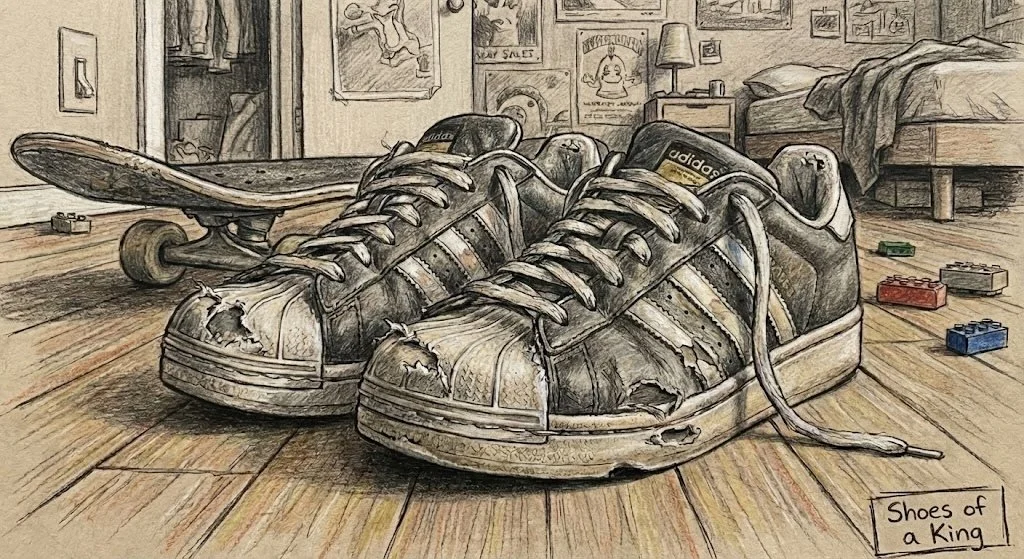
Shoes valued at 1 Million Euros by a boy in Germany
They were wrecked. The soles were worn thin. The sides were shredded in exactly the places you’d expect if someone had spent hundreds—maybe thousands—of hours on a board. These weren’t neglected shoes. They were earned shoes.
When asked why they mattered, the boy explained that they proved he had put in the time. The hours. The falls. The repetitions. They showed that he wasn’t just someone who skateboarded—he was someone who had mastered it.
In his words, they showed he was “a king” in the skateboard world.
Not a king because he owned something new.
A king because he had climbed the hierarchy of skill.
He could now teach others. He had authority. He had status—not assigned, but earned.
Then someone asked him what the shoes were worth.
He thought for a moment and said: one million euros.
Not as a joke.
As a statement of fact.
Because to him, those shoes were not footwear. They were proof of identity. A visible ledger of time invested. A record of mastery that no amount of money could buy or fake.
And that’s when something clicked for LEGO.
They realized they had misunderstood play.
They had been designing for novelty, features, and surface excitement—when what kids actually value is depth. They value progression. They value hierarchy. They value the slow, often invisible journey from novice to someone who knows enough to teach.
Play, for kids, isn’t shallow. It’s serious.
LEGO bricks weren’t competing with other toys. They were competing with anything that offered a path to mastery. And LEGO’s power—when it worked—was that it rewarded time spent. The more you invested, the more the system gave back. Old bricks still mattered. Skill accumulated. Creations improved. Status emerged naturally among peers.
Just like skateboarding.
The company had almost lost that truth by chasing variety instead of meaning.
That German boy’s shoes helped them remember it.
Not because they were special objects—but because they represented something universal: humans want to become someone through effort.
Kids don’t want shortcuts. They don’t want everything to be easy. They want challenges that leave marks—on their hands, on their work, on their identity. They want artifacts that say I put in the time.
That’s what those shoes were.
And that’s what LEGO, at its best, had always been.
Not a toy.
A system that honors mastery.
A place where, brick by brick, you can earn your way to becoming a king.