When artificial intelligence makes answers nearly free, the most valuable human skill may be knowing which questions deserve to be asked.
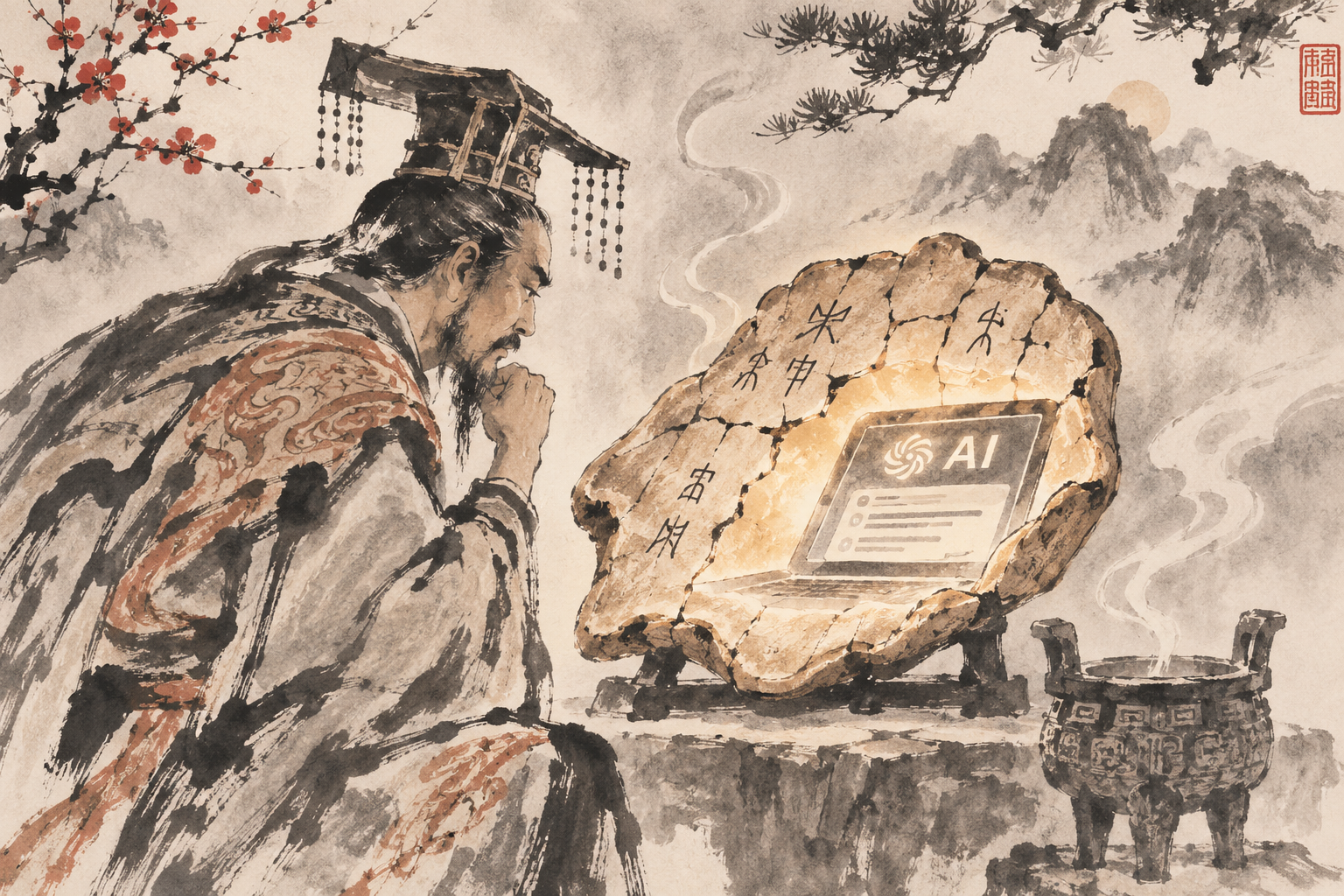
More than three thousand years ago, the rulers of ancient China had an unusual way of making important decisions. They would pose questions about the future, inscribe them on tortoise shells, and heat them until the shells cracked. Specially trained diviners would interpret the patterns, searching for guidance from the ancestors about everything from the coming harvest to whether a military campaign would succeed.
This practice, known as oracle bone divination (甲骨占卜), flourished during the Shang dynasty and left behind some of the earliest surviving examples of Chinese writing.
It's easy to smile at the idea of seeking wisdom in the cracks of a tortoise shell. But I find something fascinating about this ancient ritual, particularly as we enter the age of artificial intelligence.
The king couldn't simply approach the oracle and ask for wisdom. He first had to decide what he wanted to know. The question had to be framed, the uncertainty identified, and the decision brought into focus before the ritual could begin.
Three thousand years later, we've replaced the tortoise shell with a computer screen and the diviner with artificial intelligence. The answers arrive without fire, smoke, or cracked shells, and with considerably more sophistication. But there's a remarkable continuity in the process.
The quality of what we get still depends enormously on the quality of what we ask.
And I believe this is about to become one of the most important skills we can teach the next generation.
Without the ability to ask the right questions,,we risk becoming extraordinarily efficient at solving the wrong problems.
When answers become free, questions become valuable
For most of human history, answers were expensive. Acquiring knowledge required access to teachers, libraries, universities, or people with specialized expertise. Even after the internet made information widely accessible, finding a useful answer still demanded considerable effort. We had to search, read, compare, and synthesize what we discovered.
Artificial intelligence is changing that equation dramatically.
We can now ask a machine to explain quantum physics, analyze a business strategy, write computer software, or suggest a treatment for a struggling tomato plant, and receive a thoughtful response in seconds. The marginal cost of generating another answer is rapidly approaching zero. But something curious happens when answers become abundant. Their abundance doesn't necessarily make us wiser. An AI system will cheerfully produce an impressive answer to a poorly conceived question. It may spend thousands of words helping us solve a problem that doesn't actually exist, optimize something that doesn't matter, or pursue a strategy based on assumptions we've never bothered to examine.
The machine can be brilliant at answering the question we asked, yet completely unhelpful with the problem we actually face. This changes where human value resides.
When answers were scarce, we rewarded people for knowing them. We built educational systems around acquiring knowledge, remembering facts, and demonstrating that we could reproduce the correct answer on an examination. Those abilities still matter, but they are no longer sufficient. In a world where almost anyone can produce a plausible answer to almost anything, the greater advantage may belong to the person who recognizes which questions are worth pursuing in the first place.
AI is making answers cheaper. It's making good questions more valuable.
The wisdom of the 55 minutes
There's a famous quotation, widely attributed to Albert Einstein, suggesting that if he had an hour to solve a problem, he would spend 55 minutes understanding the problem and just five minutes finding the solution.
Most of us are far too eager to begin answering. We encounter a difficulty and immediately start looking for solutions. A product isn't selling, so we ask how to improve marketing. Employees are leaving, so we ask how to improve retention. Students are struggling, so we ask how to improve test scores.
But perhaps the product isn't solving an important problem. Perhaps employees are leaving because we're hiring people who want something different from what our company offers. Perhaps the students aren't struggling to learn at all, but are struggling to find meaning in what we're asking them to learn.
The first question often reflects our assumptions about the problem rather than the problem itself.
This is where curiosity, skepticism, and imagination become so valuable. The ability to step outside our initial framing, challenge what we think we know, and look for a more revealing question is what separates genuine insight from merely efficient problem-solving. And AI makes this distinction more consequential. When the cost of producing an answer was high, we had some natural incentive to think before asking. Now that answers arrive instantly, it's tempting to skip the thinking altogether.
We risk becoming extraordinarily efficient at solving the wrong problems.
The danger of outsourcing our curiosity
I worry that we're approaching a moment when the convenience of AI could weaken precisely the intellectual muscles we most need to strengthen. Consider a child who grows up with an infinitely patient, extraordinarily knowledgeable AI companion. Whenever a question arises, the answer is immediately available. There's no need to struggle through uncertainty, search for alternative explanations, or sit with a problem long enough to discover that the original question was misguided.
This could be a wonderful educational opportunity, or it could become an intellectual trap. The difference will depend on how we teach children to use these remarkable tools.
Imagine two students given the same assignment. One asks AI to explain the causes of the Roman Empire's collapse and receives a beautifully organized summary. The other begins by wondering whether the Roman Empire really collapsed at all, why historians disagree about what constitutes a collapse, and what lessons, if any, we can legitimately apply to modern societies. Both students have access to the same machine. But they are developing very different intellectual capabilities.
The first is learning to obtain answers. The second is learning to think.
The irony is that the second student can also use AI to become a much better thinker. They can ask it to challenge their assumptions, introduce competing perspectives, identify weaknesses in their reasoning, and suggest questions they haven't considered. The technology that threatens to make us intellectually lazy can also become the greatest tool ever invented for developing intellectual curiosity. But only if we use it that way.
Teaching the next generation to become oracles
This brings me back to those ancient Chinese tortoise shells. The Shang kings depended on diviners to interpret the answers they believed the shells contained. Today, we have machines capable of producing answers on a scale those ancient rulers could never have imagined. But our children shouldn't grow up merely learning how to consult the oracle.
They need to learn how to become oracles themselves.
Not in the supernatural sense, of course, but in the much more important human sense: developing the judgment to recognize what matters, the curiosity to frame a meaningful question, and the wisdom to distinguish a useful answer from a convincing but worthless one.
I think this requires us to rethink what we teach, how we teach it, and what we reward.
Instead of always giving students questions and grading their answers, why not sometimes give them a situation and ask them to develop the questions? Present a complex problem with incomplete information, and challenge them to identify what they need to understand before attempting a solution. Then let them use AI to explore those questions, test their assumptions, and refine their thinking. But don't stop when the machine produces an answer. Ask the students to explain why they believe it. What evidence supports it? What might make it wrong? What important considerations were overlooked? What would they do differently if the answer turned out to be misleading?
And perhaps most importantly, ask them whether they are still pursuing the right question.
We could make this a regular discipline in schools and workplaces alike. Give people an unfamiliar challenge, allow them to use every available AI tool, and evaluate them not simply on the elegance of their final solution but on the quality of the questions they developed along the way. Reward the student who discovers that the original problem was poorly defined. Celebrate the employee who challenges a comfortable assumption. Encourage the future leader who has the confidence to say that everyone is racing toward an answer before anyone has understood the question.
These are not new intellectual virtues. Great scientists, philosophers, entrepreneurs, and teachers have practiced them for centuries. What's new is the urgency with which we need to cultivate them.
The question is the future
The Shang dynasty's oracle bones are extraordinary artifacts because they preserve the questions people asked more than three thousand years ago. The answers, divined from cracks in bone and shell, tell us much about ancient beliefs, but very little about how the future actually unfolded. The questions, however, remain recognizable. Will this decision succeed? What dangers lie ahead? What should we do next?
Humanity has always sought answers to uncertainty. What's changing is our ability to produce them. As AI becomes more powerful, we'll be surrounded by answers that are faster, cheaper, more persuasive, and often more useful than anything previous generations could have imagined. But the responsibility for deciding what deserves our attention, what is true, and what we should do with what we learn will remain ours.
Perhaps the most important change we can make in education is to stop treating the question as something the teacher provides and the answer as something the student must produce. In a world where AI can generate answers almost effortlessly, we should reverse that relationship. Give students problems worth thinking about, let them use AI freely, and teach them to master three skills I call the Three Qs: Question, Query, and Qualify.
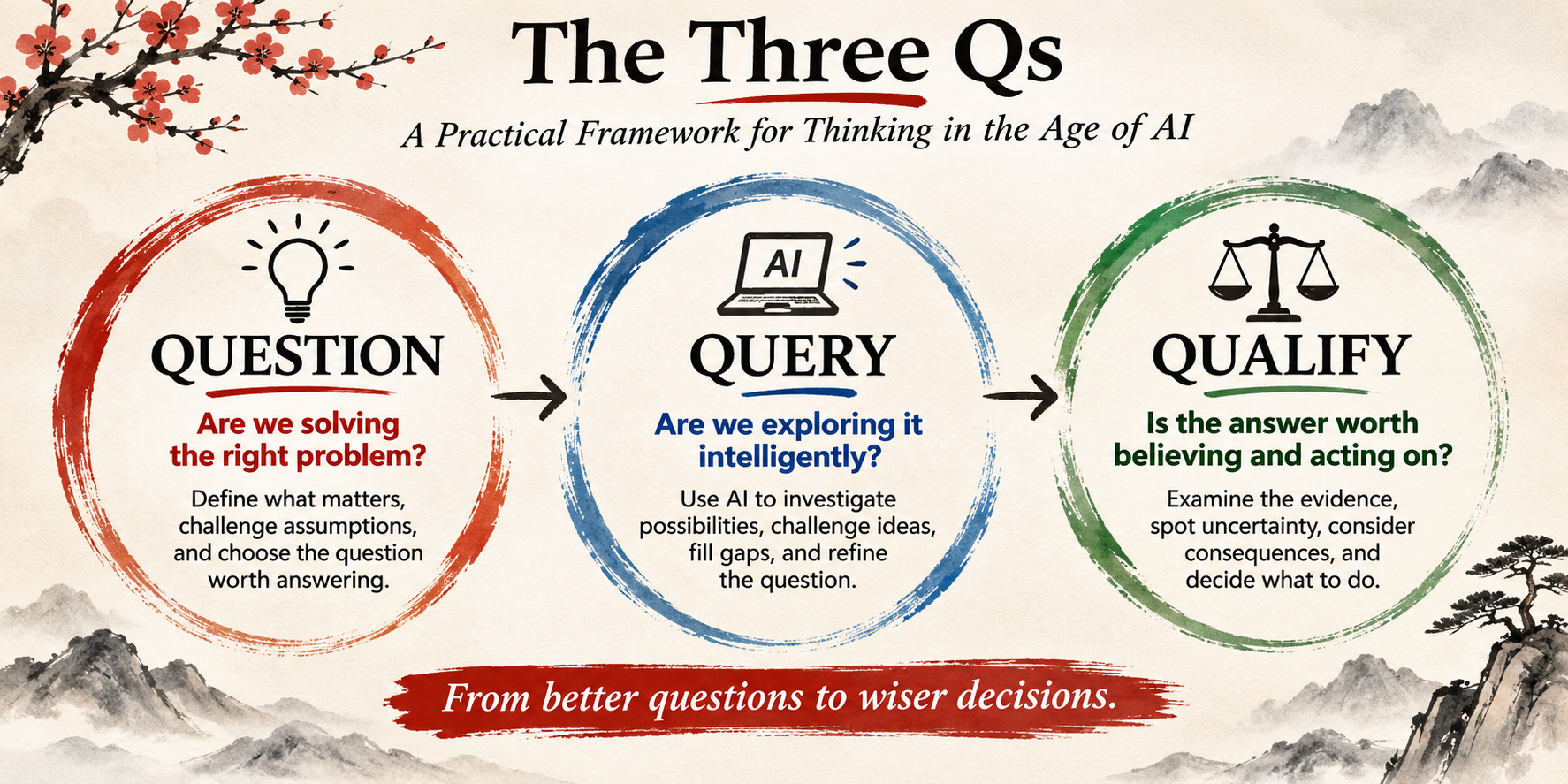
Three Q’s: a framework for critical thinking in the AI-enhanced world.
First, Question. Before looking for an answer, learn to identify the problem worth solving. What are we really trying to understand? What assumptions are we making? Is there a more important question hiding behind the obvious one?
Second, Query. Learn to use AI not simply to produce answers, but to explore possibilities, challenge assumptions, and discover what we don't yet know. A good conversation with AI should leave us with better questions as well as better answers.
Finally, Qualify. Learn to judge what comes back. Is the answer supported by evidence? What might be missing or misleading? Does it actually help us make a better decision? And what would change our minds?
Imagine an education system in which students were regularly given difficult, ambiguous problems and evaluated on these three abilities. They would have access to all the AI tools they wanted, but their grade would depend on the quality of the questions they developed, how intelligently they explored them, and whether they could defend the conclusions they reached.
The same approach could transform how we develop leaders in business. Instead of rewarding the person who arrives at a meeting with the quickest answer, we might start recognizing the person who identifies the question nobody else thought to ask.
Three thousand years ago, Chinese kings consulted tortoise shells because answers were difficult to obtain. Today, we're building machines that can generate answers to almost anything, almost instantly. But the machines can't relieve us of the responsibility to decide what matters, what to believe, and what to do next.
The next generation doesn't need to become better at consulting the oracle. It needs to become better at being the oracle.
And that begins by teaching them not just how to answer questions, but how to question the answers.