Crossing The CHASM To LEADER
Most careers don’t fail because people stop trying. They fail because people keep doing the wrong job for too long.
The tricky part is that no one ever tells you when the job has changed. You’re just told you’re doing well. Then you’re given more responsibility. And suddenly, the same behaviors that made you successful start producing friction instead of progress.
It feels personal. But it isn’t. It’s structural.
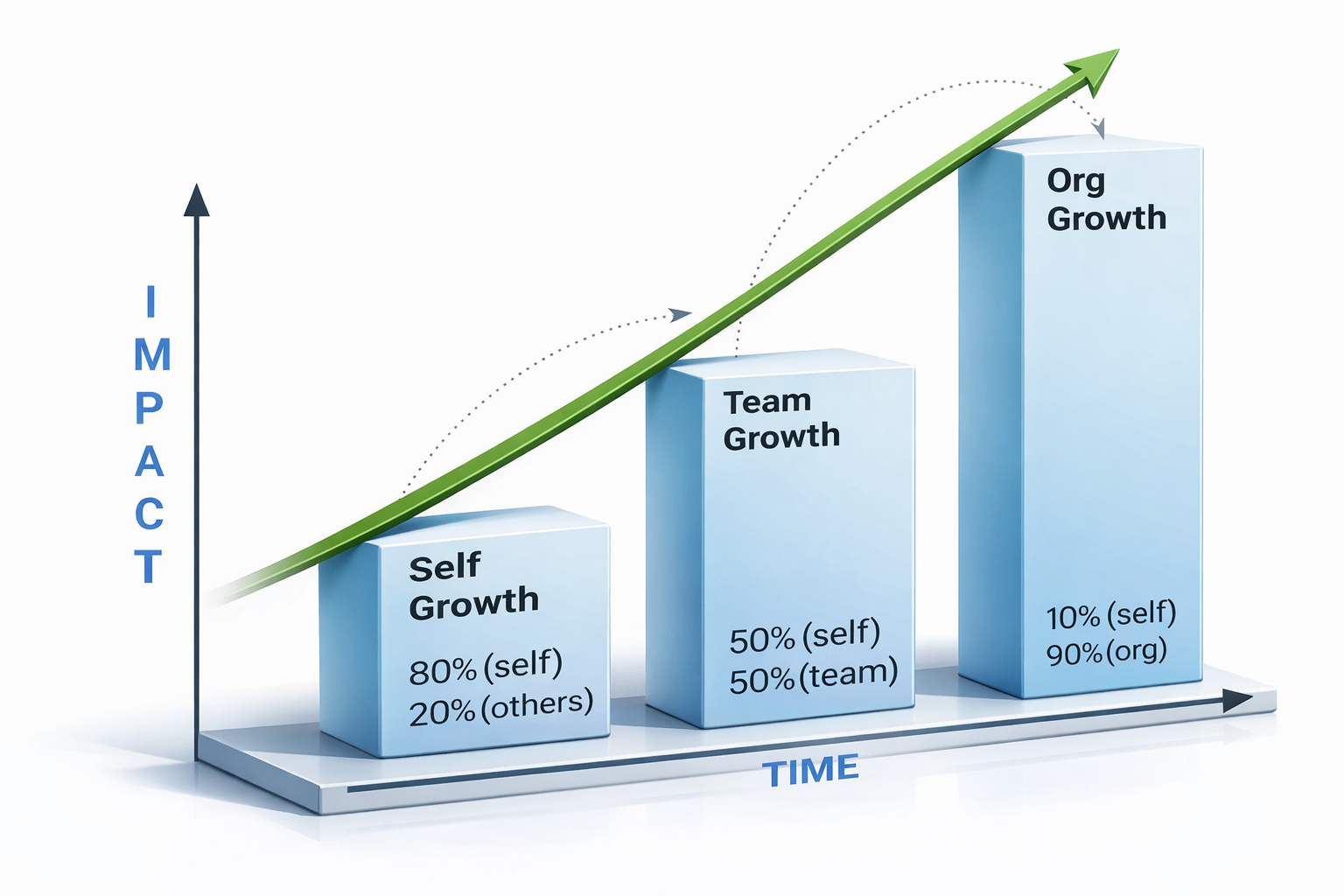
The three stages of shifting from being an individual contributor to a leader
The First Stage: Learning How to Be Useful
Early in your career, the job is simple — even if the work isn’t. You are there to learn how to be useful. You learn the tools. You learn the language, the industry-specific vocabulary required to “talk the talk”. You learn what “good” looks like in your craft.
Your impact is direct and tangible. If you put in the effort, results show up quickly. When you improve, the output improves with you. The feedback loop is tight and mostly fair.
At this stage, most of your growth comes from yourself. From curiosity. From practice. From asking questions you’re not supposed to ask yet.
This is the phase where effort and reward are closely linked, and because of that, it’s deeply satisfying.
It’s also where many people form an identity: I am the person who gets things done.
That identity will eventually need to loosen.
The Second Stage: Letting Go of the Thing You’re Best At
If you’re good at the first job, you’ll eventually be invited into the second one. It usually sounds flattering.
“Can you help mentor the new hires?”
“Can you take ownership of this small team?”
“We think you’re ready for more responsibility.”
What no one says out loud is that this isn’t a promotion — it’s a transition into a completely different kind of work. The second job is no longer about your output. It’s about other people’s output. And that shift is jarring.
At first, it feels like you’re getting worse at everything. You have less time to do the work you’re good at. Your calendar fills with conversations instead of tasks. Progress becomes harder to measure. Wins feel less clean.
This is where many people panic quietly.
They respond by grabbing back the work, fixing things themselves, staying late, proving — to themselves and others — that they still “have it.”
But that instinct, while understandable, is exactly what keeps people stuck.
The second job requires learning to grow others rather than outperforming them. It requires patience, restraint, and a tolerance for messiness that the first job never demanded.
This is the stage where growth slows down on the surface, even though something deeper is happening underneath.
It’s not a failure.
It’s the cost of learning leverage.
The Third Stage: Shaping the System Instead of the Work
Most people end up struggling forever in second stage jobs, developing a love-hate relationship with their careers. Some escape out of the second stage and go back to the controllable comfort of a first stage, individual contributor role. A select few, whether our of necessity or their ambitions eventually drift into a third phase role, often without realizing it at first.
The work becomes less visible again — but for a different reason.
Now, success isn’t about what you do or even what your team does. It’s about whether the system works. Whether decisions are clear. Whether priorities make sense. Whether the environment allows good people to do good work without heroics.
This is where leadership starts to look deceptively quiet.
From the outside, it can seem like less is happening. Internally, everything is happening at once — culture, incentives, tradeoffs, timing.
Your impact is delayed. Indirect. Hard to point at. And deeply compounding.
At this stage, very little of your growth comes from personal effort. Most of it comes from how well the organization grows around you.
If things are working, you’re almost invisible.
And that’s the point.
Why These Transitions Feel So Uncomfortable
Each of these stages asks you to give something up.
First, you give up certainty.
Then, you give up control.
Eventually, you give up visibility.
What makes these transitions hard isn’t the workload — it’s the identity shift.
Each stage rewards a different version of you. And if you cling too tightly to the old one, the next stage feels like rejection instead of growth.
Careers don’t move in straight lines. They move in plateaus and chasms. Long stretches of learning, followed by moments where the ground seems to drop away.
Those moments are not warnings.
They’re invitations.
A Question Worth Sitting With
Whenever your role starts to feel harder than it should, there’s a simple question that’s worth asking:
Where is my impact supposed to come from now?
If the answer has changed — and your behavior hasn’t — friction is inevitable.
Growth doesn’t mean doing more of what already worked.
It means learning when to stop.
And then, slowly, learning how to work again — in a new way.