Train so your last words aren’t “Oh Sh*T”
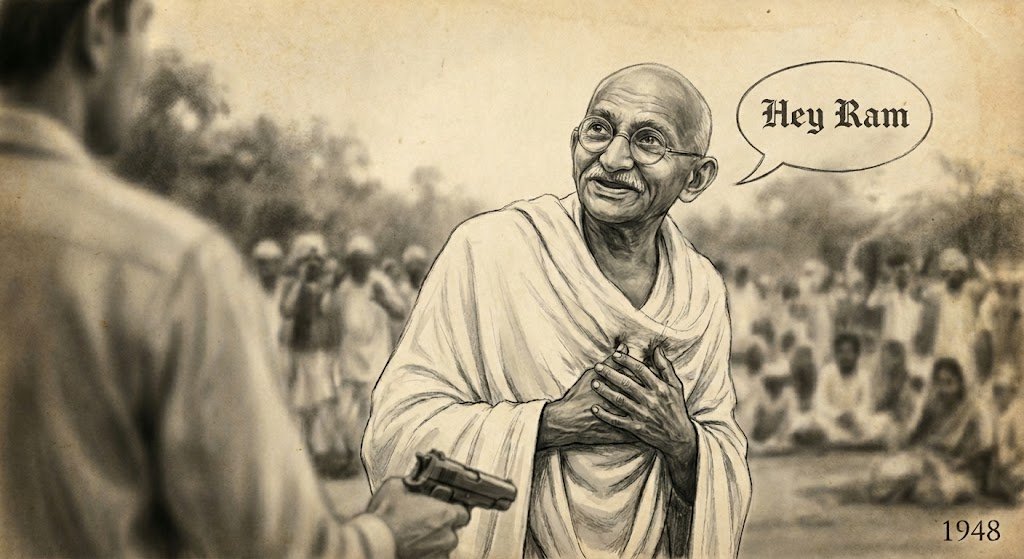
After being shot by an assassin, Gandhi’s last words were purported to be “Hey Ram” which is a greeting to God in Hindi
When Mahatma Gandhi was assassinated, witnesses said his last words were: “Hey Ram.” which means “Oh Lord.” Not rage. Not panic. Not “Who did this?” Just surrender. Awareness. Presence. The point is this: under maximum surprise…he didn’t default to chaos. He defaulted to his training.
Which raises an uncomfortable question:
If something unexpected hit you today — an incurable cancer diagnosis, complete financial collapse, a car running a red light into you while crossing the street —what would your reflex be? Be honest. Would it be: “Oh sh*t.”
That is not a strong closing line on your life. If you get 80 years to prepare and that’s your exit…that’s poor training. So here’s the pitch:
In your daily life, train yourself to be amazed, even curious, when surprised.
You Don’t Rise To THE OCCASION. You Default TO YOUR TRAINING.
We like to think we rise to the occasion. We don’t. We default to conditioning. You are not really a rational person making clean decisions in the heat of the moment. You are a stack of habits with a busy life and an internet connection.
Your habits determine:
• how you respond in meetings
• how you respond to your spouse
• how you respond to volatility
• how you respond to bad medical news
If your daily habit is:
• complain
• defend
• blame
• panic
Then your final macro-moment will be beautifully consistent. On brand. “Oh sh*t.”
How we live is how we die. And if there is anything beyond this life, you don’t get a personality reset at the exit door. You bring your conditioning with you.
MIND The Gap
Surprise is inevitable. Suffering is largely a narrative we tell ourselves. Between stimulus and story lies a gap. That gap is trainable.
Most of us train the opposite reflex:
• defensive
• outraged
• indignant
• anxious
• catastrophizing
We practice “Oh sh*t” daily.
But what if we practiced:
• curiosity
• humor
• wonder
• amazement
When the plan changes. When the meeting implodes. When the cancer tumor shows up on the MRI. When the important business deal dies. When the kid does something shocking at school.
Instead of tightening, we soften. Instead of collapsing, we lean in. Instead of “Oh sh*t” — we say “Oh. Wow.”
Why This Is Strategic
Surprise is not an edge case in business. Surprise is the default operating environment. If your nervous system collapses under surprise, your strategy collapses under volatility.
Habits → Actions → Outcomes → Trajectory → Identity → Destiny
Habits shape actions.
Actions shape outcomes.
Outcomes shape trajectory.
Trajectory shapes identity.
And identity shapes destiny.
And identity scales. As leaders, our reflex becomes culture. If we panic, the org panics. If we turn, the org turns.
Why This Matters
This is not just spiritual poetry. This is performance. Leaders who can metabolize surprise:
• make better decisions under volatility
• don’t transmit panic to teams
• see opportunity faster
• recover faster
Surprise is the only guaranteed input in life and business. If your nervous system is fragile around surprise, your strategy will be fragile too.
But if surprise energizes you, you become antifragile.
And the deepest layer: If you practice meeting small shocks with curiosity, you won’t be blindsided by the big one. You may not get to choose when you die. But you might influence how you meet it.
The Practice
1. Catch the first word.
When something goes wrong today, notice the immediate internal language. Is it outrage? Is it blame? Is it self-pity? That’s your conditioning talking.
2. Swap “Why?” for “Interesting.”
“Interesting” creates space. It turns threats into data begging to be analyzed.
3. Practice micro-amazement.
Missed flight? Interesting. Kid meltdown? Fascinating. Big deal falls apart? Intriguing.
Do that, and you’re rewiring your reflex. You are rehearsing your future in small moments. If you want to shape who you are and what you become, shape your habits carefully.
Train for the gap.
Train for “Wow.”