I have a friend who is a successful entrepreneur. When a customer is unhappy, he calls and resolves their issues immediately. When a deal stalls, he finds another way forward. He has built his business by taking initiative, usually before he has all the answers. For the sake of this article, I will call him "David."

At home, he operates differently. He and his wife barely talk beyond logistics. His children have stopped expecting him to be available. He knows there’s a problem, but business has been demanding. Once things settle down, he thinks, they’ll reconnect. David would never accept that reasoning from someone responsible for an important customer. Yet with the people he loves most, he is waiting for circumstances to improve.
That contradiction interests me. We can be remarkably proactive in one part of our lives and strangely passive in another. Often, we have perfectly reasonable explanations for the part we’re neglecting.
In The 7 Habits of Highly Effective People, Stephen Covey describes a man who tells him he no longer feels love for his wife. Covey tells him to love her. The man repeats that the feeling is gone. Covey replies:
“My friend, love is a verb. Love—the feeling—is a fruit of love, the verb. So love her. Serve her. Sacrifice. Listen to her. Empathize. Appreciate. Affirm her. Are you willing to do that?”
The last question gives the passage its force. Covey has moved the conversation from a feeling the man cannot summon to actions he can choose. We often get that sequence backward. We wait for confidence before attempting something difficult, motivation before starting, affection before making a loving gesture. Yet those feelings can develop through the very actions we’re postponing. Covey’s broader principle is “act or be acted upon.” I’ve seen what that choice can produce.
In 2003, I was building Brocade’s Asia Pacific operation when the SARS pandemic stopped the travel our business depended on. We relied on visiting technical experts, and major partners were recalling their expatriate leaders. Many of my peers settled into waiting for travel to resume. Our customers still needed help. We gave local managers and engineers the authority to own those relationships, developed ways to solve technical problems remotely, and brought training into local languages and local teams.
While others waited, we were working alongside customers. By the time travel resumed 8 months later, we had stronger local leadership and deeper relationships than our old model had ever produced. Competitors could send their experts back. They couldn’t catch up on months of earning customers’ trust simply by getting on a plane.
We had built an advantage by responding to circumstances we couldn’t change. Waiting would have been easy to defend. That is what makes errors of omission so dangerous. Humans pay closer attention to errors of commission: the bad hire, the failed investment, the decision that costs us money. Someone did something, and it went wrong. There is evidence. Errors of omission leave less obvious evidence. The customer we never called. The idea we never tested. The conversation we avoided until the relationship had little left to sustain it. We rarely measure what those failures to act have cost us.
David can get through another evening without an argument and imagine that nothing has changed. Meanwhile, his family is learning to live without his involvement.
Our language often reveals this retreat before we recognize it. Covey contrasts reactive language with proactive language: “There’s nothing I can do” becomes “Let’s look at our alternatives.” “That’s just the way I am” becomes “I can choose a different approach.” “If only” becomes “I will.”
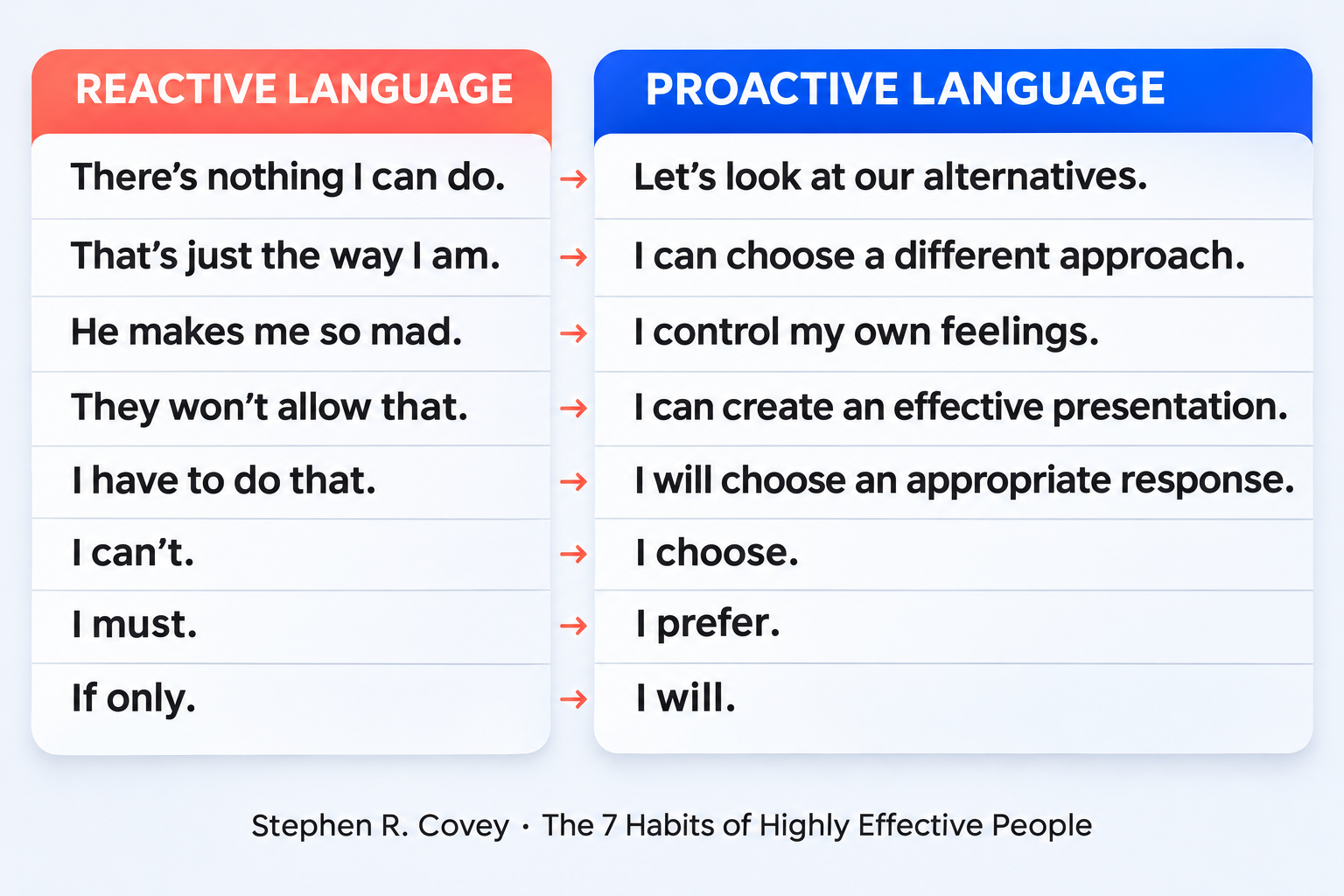
The words we use reveal how we see our ability to take action.
These changes matter when they lead to a different decision. “I don’t have time” closes the discussion. “I haven’t made time” opens an uncomfortable but useful question about what we are choosing.
We don’t cause every problem in our lives, and initiative cannot guarantee the outcome we want. But explaining our circumstances can become a substitute for addressing the part within our reach.
Three things seem worth practicing:
Notice what you keep explaining. A recurring explanation may be pointing to a decision you’re avoiding.
Count the cost of doing nothing. Alongside “What if this goes wrong?” ask, “What happens if I leave it alone?”
Turn the intention into a specific act. Make the call. Ask the question. Keep the commitment. Give someone your full attention.

Love is an action verb. Love, the noun, is the fruit of those actions.
David doesn’t need to solve his entire marriage tonight. He can ask his wife how she’s been feeling and listen without defending himself. He can make a promise to his children and keep it. Those actions are within reach before business settles down, before he knows what to say, before the feeling returns.
Love her, Covey said. I would add, don't forget the best form of the word love is when it is a verb. Doing those actions creates the "feeling" of love that we see in movies, read about in novels, and aspire to in our own lives.