Plan for Adversity, NOT for SMOOTH SAILING.
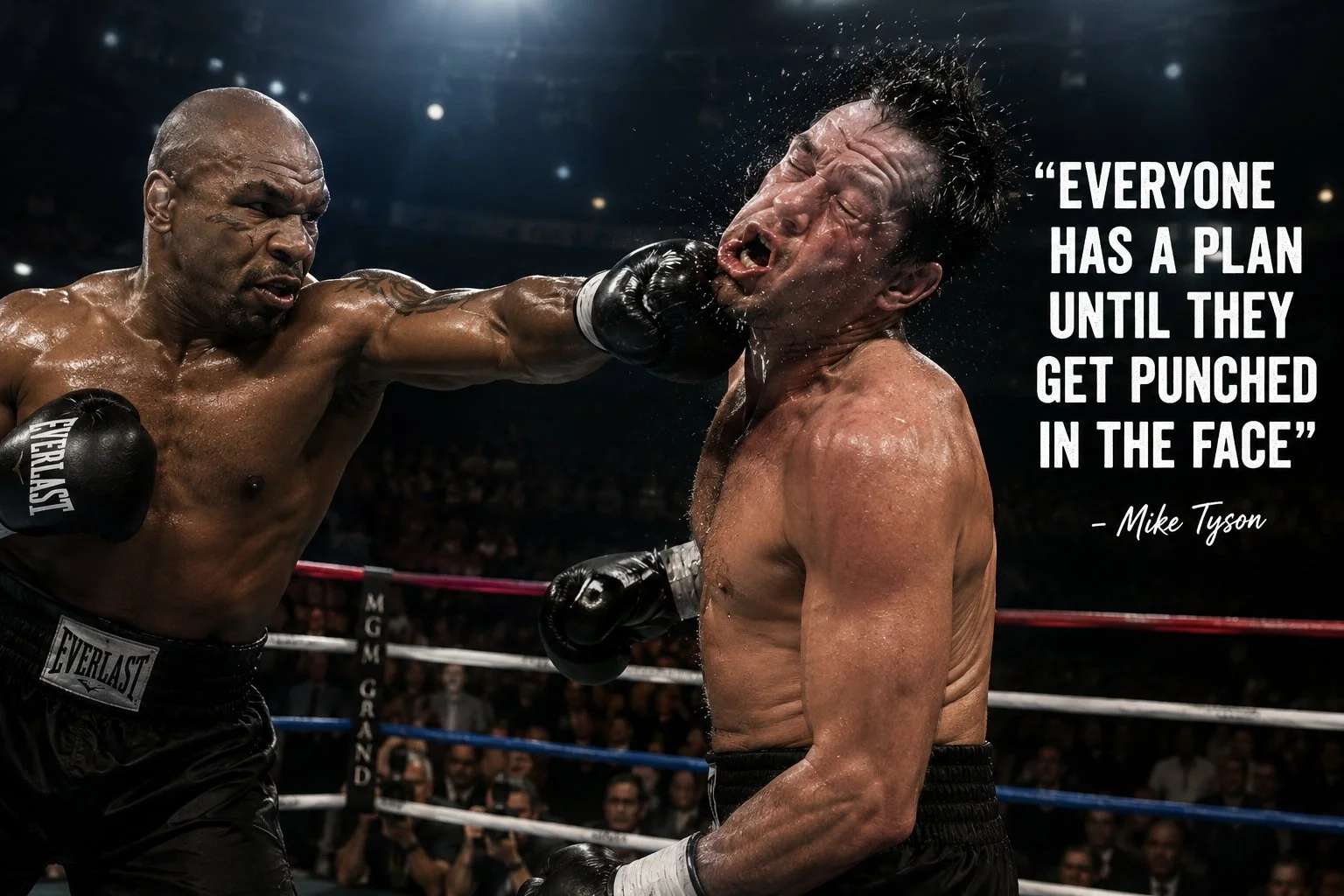
There’s a line I’ve been thinking about lately:
“Calm seas offer rest; rough seas teach us how to sail.” Roughly translated into Chinese: 风平浪静让人休憩,惊涛骇浪教人掌舵。
I like it because it flips our normal relationship with adversity.
We spend an enormous amount of our lives trying to make the seas calm. We work to get the money and savings right, the career right, the family right, and our health right. We buy the house, make the plan, eliminate uncertainty, reduce risk, and generally try to arrange our lives so that everything runs as smoothly as possible. And there’s nothing wrong with that. Who doesn’t want a little smooth sailing?
But then life does what life does. The weather changes. Abruptly. Unexpectedly.
CALM SEAS ARE GREAT. THEY JUST DON’T TEACH YOU MUCH.
There is nothing wrong with calm seas. In fact, we need them. Rest matters. Recovery matters. Peace matters. There are times in life when the best thing we can possibly do is sit back, enjoy the sunshine, and appreciate that, for the moment at least, the surface of the water is calm
The problem is that you don’t learn much about sailing when the wind is perfect. You learn when the wind suddenly changes direction, when something breaks, when the forecast turns out to be wrong, or when the waves get much bigger than you expected. You learn when the carefully constructed plan that looked brilliant yesterday suddenly becomes irrelevant today. Those are the moments when you discover what you really know and are capable of. More importantly, they are the moments when you discover what you don’t know.
Helen Keller put it beautifully: “Character cannot be developed in ease and quiet.”
I think I’d go one step further. Character isn’t merely revealed by adversity. Character is built by it.
THE MUSCLE NEEDS THE WEIGHT
Think about the way the human body gets stronger. We deliberately apply stress to it. We lift something heavy. We run farther. We push the heart and challenge the muscles. Then we recover. The body gets the message: Apparently, we need to be capable of handling these deliberate encounters with stressors. So it adapts. Muscles grow. Bones strengthen. Cardiovascular capacity improves. Something that temporarily makes us weaker ultimately leaves us stronger, provided, of course, that the stress doesn’t overwhelm us and that we give ourselves enough time to recover.
Why should we expect character to work any differently?
The small difficulties we encounter prepare us for the larger ones. Disappointment teaches us how to recover. Uncertainty teaches adaptability. Failure teaches humility. Loss teaches perspective. Fear teaches courage, because without fear there really isn’t much need for courage in the first place. We can read about these qualities. We can admire them in other people. We can talk about the importance of resilience, courage and adaptability all day long. But that isn’t how we acquire them.
We develop them under the load of unexpected adversity.
Becoming RESILIENT ISN’T ENOUGH
Nassim Nicholas Taleb gave us a useful word for this: antifragile.
A fragile thing breaks under stress. A resilient thing withstands the stress and eventually returns to where it started. But an antifragile thing does something much more interesting: it becomes better because it was stressed.
Taleb captures the distinction with a wonderful metaphor: “Wind extinguishes a candle and energizes fire.” Be the fire.
That strikes me as a much more ambitious objective than simply becoming resilient. I don’t merely want to survive difficult experiences, recover from them, and eventually return to the person I was before. I want to extract something from them. I want to come away with more capability, more perspective, more courage, more gratitude, better judgment, and a larger emotional operating range. I want the next difficult experience to encounter a person who is better equipped to handle it because of the difficult experiences that came before.
Put another way: if I go through hell and come out exactly the same, I’ve wasted a big part of the journey.
DON’T WASTE A GOOD STORM
Thinking this way changes the question we ask when something difficult happens. The instinctive question is usually, “Why is this happening to me?” It’s a perfectly understandable question. It’s also, much of the time, a fairly useless one.
A more interesting question might be: “What is this preparing me for?” Or perhaps: “What capability am I being forced to develop right now?” That doesn’t mean pretending that bad things are somehow good. Some things just suck. Loss is loss. Pain is pain. A storm is still a storm.
Antifragility isn’t about enjoying the storm. It’s about refusing to waste it. Because once you have navigated one genuinely rough sea, something changes. The next time the sky darkens, you have a reference point. You can tell yourself: I’ve seen weather like this before.
I know what panic feels like. I know what uncertainty feels like. I know that carefully made plans can collapse in an instant. But I also know that I can think. I can adapt. I can ask for help. I can change course. And I can keep moving.
Yesterday’s storm becomes tomorrow’s more enlightened and capable seamanship.
WE MAY BE PROTECTING OURSELVES TOO MUCH
All of this also makes me wonder whether our obsession with removing difficulty from life is always as healthy as we assume. We do it to ourselves. We do it to our teams. And perhaps most of all, we do it to our children. Our instinct is to remove the disappointment before they have to experience it. We fix the problem. We call the teacher. We talk to the coach. We intervene in the disagreement. We try to make sure everyone gets along, nobody fails, and the seas remain as calm as possible. It comes from a good place. But there’s a tradeoff.
A child who never encounters rough water never learns to sail. Neither does an adult.
Maybe the job isn’t to remove every wave from someone’s path. Maybe it’s to make sure the waves are survivable, stand close enough to help if necessary, and then let them figure out how to keep the boat upright. Because the goal cannot be a life without storms. That option isn’t realistic anyway.
The goal is to become the kind of person who knows what to do when the storm arrives.